Renting vs Buying a Home: The Real Costs Compared (2026)
"Rent is throwing money away" is a slogan, not an analysis. Both renting and owning have unrecoverable costs — money that buys no equity. Rent is one. On the ownership side: interest, property tax, insurance and maintenance are equally gone. The honest comparison lines those up, then asks how long you will stay.
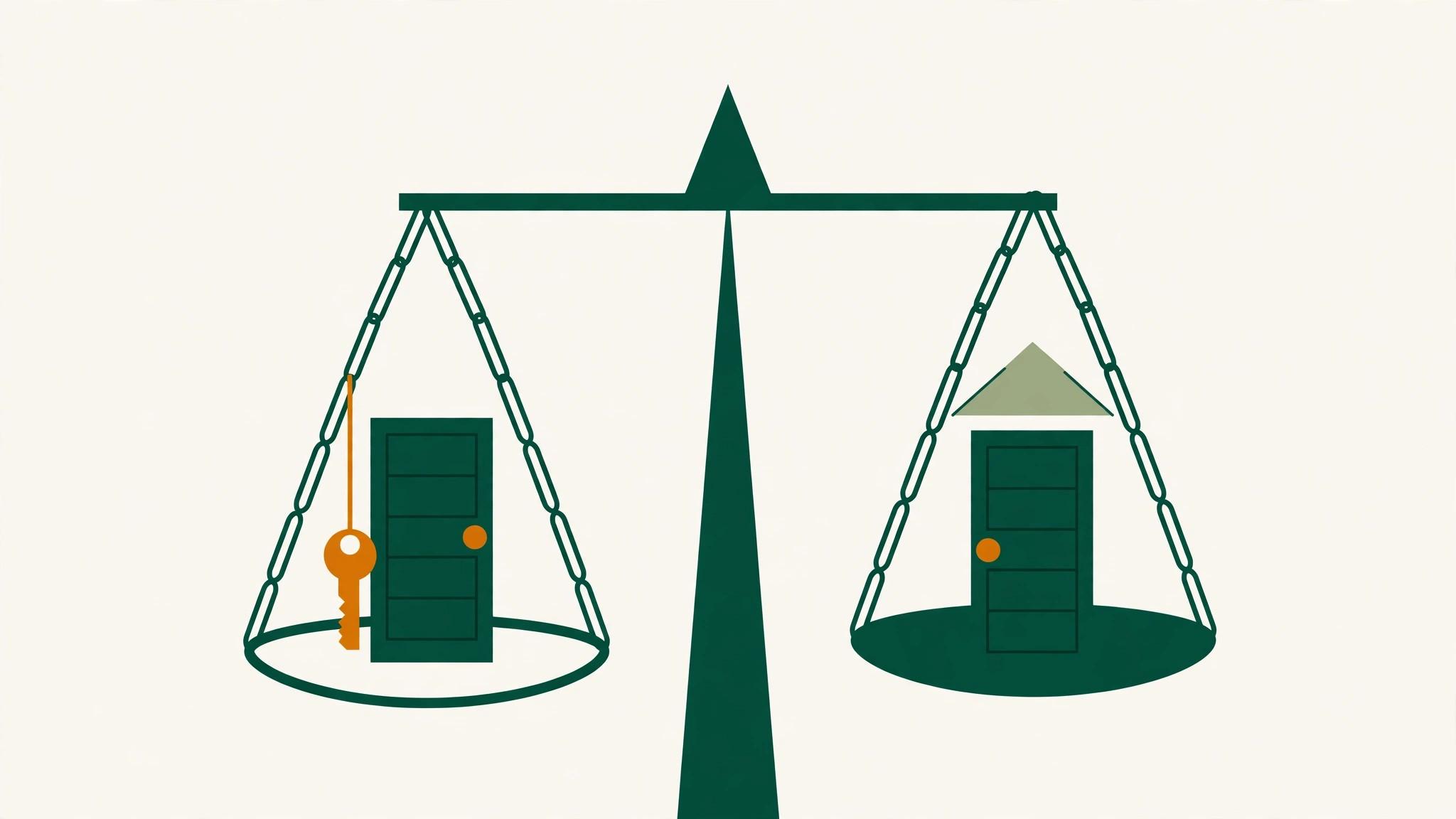
Unrecoverable costs, side by side
On a $450,000 home bought with 20% down at 6.5%, the first year's unrecoverable ownership costs are roughly: $23,000 interest, $5,400 property tax, $2,200 insurance, $4,500 maintenance — about $35,000 that builds no equity, against $31,000 of principal paid down... no: principal is the recoverable part, and in year one it is only about $7,000 of the payments. Compare renting the same home at $2,400 a month: $28,800 unrecoverable. In year one, renting is often cheaper than owning on a pure cost basis.
Time reverses it. Rent rises with the market; a fixed mortgage payment does not, and its interest share shrinks every year while the principal share grows. Buying also carries roughly 2–5% in purchase costs and 5–6% in selling costs, which is why the break-even against renting usually sits between five and seven years. Stay two years and renting wins almost everywhere. Stay twelve and buying usually wins by a wide margin. The calculator exists because the answer is arithmetic, not ideology.
- A useful shortcut: if the home's price is more than ~20x its annual rent, renting is usually cheaper; under ~15x, buying usually is.
- The down payment has an opportunity cost — it could have been invested. Honest comparisons charge the buyer for it.
- Job mobility has value. Buying sells flexibility; price that in if your career moves cities.
Questions, answered
Does buying always build wealth faster?
Over long horizons, usually, because the mortgage forces saving and the asset is leveraged. Over short horizons, transaction costs and front-loaded interest routinely make it the worse choice.
What if rates fall after I buy?
Refinancing can capture lower rates, at a cost of roughly 0.5–1.5% of the loan. Renters capture falling rents only at lease renewal, and rents historically fall far less than rates.
Reviewed by Tahir Shehzad, ACMA. Figures are reviewed against the sources on our methodology page. This guide is education, not personal financial advice.