How Compound Interest Works (With Real Number Examples)
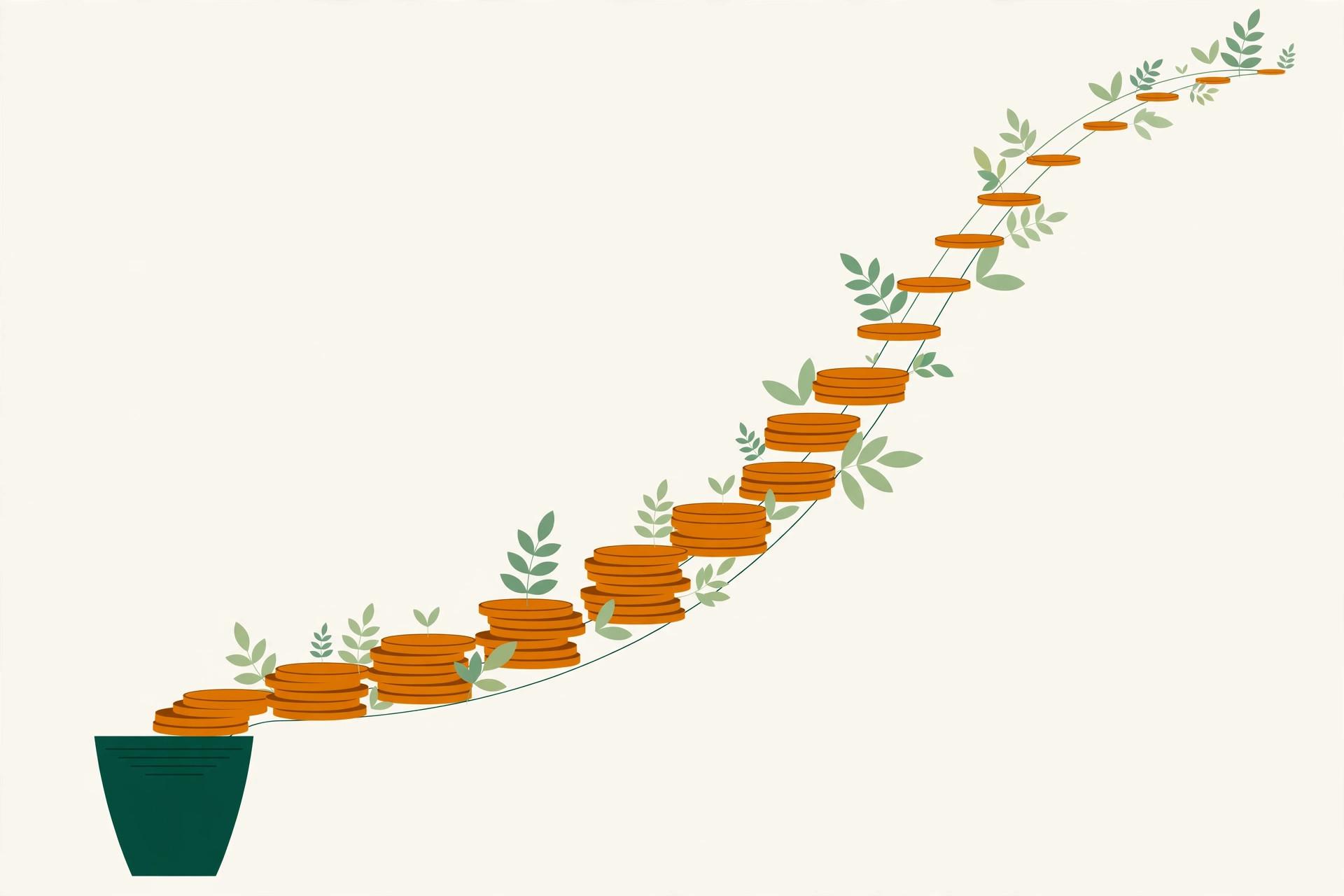
Compound interest is interest earned on interest. A balance grows slowly at first, then faster, because each year's earnings join the principal and earn their own return the year after. The effect is weak over months and decisive over decades, which is why the start date of a savings habit matters more than its size.
The formula, in plain terms
The future value of a lump sum is A = P × (1 + r)^t, where P is the starting amount, r is the annual rate, and t is the number of years. $10,000 at 7% for 30 years becomes $10,000 × 1.07^30 = $76,123. You deposited $10,000; compounding supplied the other $66,123.
Monthly contributions change the picture again. Saving $300 a month at 7% for 30 years means depositing $108,000 and ending near $365,000. More than two-thirds of the final balance is growth, not deposits. Shorten the period to 20 years and the same habit ends near $156,000 — the last decade does most of the work, which is exactly why starting early beats saving more later.
Why the rate matters less than the calendar
The Rule of 72 gives the doubling time of money: divide 72 by the annual return. At 4%, money doubles in 18 years. At 8%, in 9 years. At 10%, in about 7. Over a 36-year horizon that is the difference between two doublings and five — a balance that ends 4 times larger versus 32 times larger, from the same deposit.
Fees work in reverse. A 1% annual fee on a portfolio earning 8% does not reduce the outcome by 1%; over 30 years it removes roughly a quarter of the final balance, because every fee dollar also loses its own future compounding. Inflation does the same: at 3% inflation, a 7% nominal return is a 4% real return, and the real doubling time stretches from 10 years to 18.
- Compare accounts by APY, which already includes compounding frequency.
- A higher rate compounded monthly beats the same rate compounded yearly, by a small margin.
- What matters most, in order: years invested, total contributed, rate, fees.
Where compounding works against you
Debt compounds with the same mathematics. A credit card balance at 24% APR doubles in about three years if no payment touches the principal. Minimum payments are set low precisely so the balance survives long enough to compound in the lender's favour. The same curve that builds savings quietly is the one that makes revolving debt so hard to escape.
Questions, answered
How often is interest compounded?
It depends on the account: savings accounts usually compound daily or monthly, bonds pay semi-annually, and most investment returns are quoted as annual figures. More frequent compounding produces a slightly higher effective yield, which is what APY measures.
Is compound interest guaranteed?
On deposit accounts, yes, at the stated APY. On investments, no — returns vary year by year, and compounding applies to whatever return actually occurs, including negative years.
Reviewed by Tahir Shehzad, ACMA. Figures are reviewed against the sources on our methodology page. This guide is education, not personal financial advice.